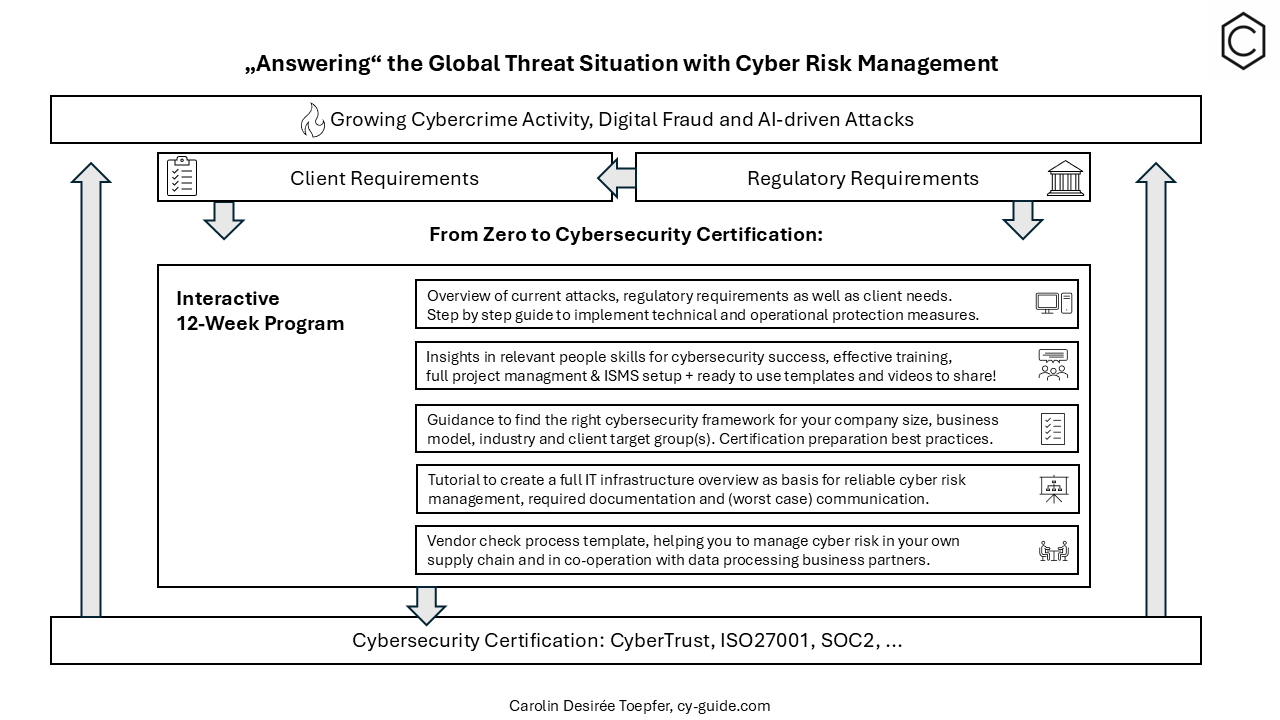
From Zero to Cybersecurity Certification
Master Cybersecurity strategically*:
15 actionable chapters, a lot of valuable insights, weekly step-by-step tutorials for each project milestone, live office hours, 2 years of access, and guidance from a real-world CISO & tech founder.
In this training, Carolin Desirée Toepfer teaches exactly the frameworks, decision models, and lean implementation approaches she uses with her clients. You’ll learn how to think like a modern security leader, cut through noise, focus on what truly matters and deliver results that move the needle, even in fast-changing and high-risk environments.
Safeguard your Business and accelerate Growth!
Your Accountability Partner:
Carolin Desirée Toepfer
is an entrepreneur and cybersecurity leader with decades of hands-on experience building digital business models and securing them in real-world environments. She has worked with startups, scale-ups, and international organizations to raise their security posture - efficiently, pragmatically, and without unnecessary complexity.
What sets Carolin apart is her ability to design lean, high-impact security processes that actually get implemented. Instead of theory or checkbox compliance, she focuses on what works: clear priorities, fast execution, and measurable results. Her work has helped teams protect critical data, manage AI and privacy risks, and build resilient security cultures, often under tight budgets and time pressure.
Carolin is widely known for translating complex cybersecurity and AI risk challenges into clear, actionable strategies that decision-makers and teams can immediately apply. As an international keynote speaker, she combines sharp insights with real stories from the field, showing not just what to do, but how to do it effectively.
From Zero to Cybersecurity Certification
Take your first step from zero to CISO-level implementation: safeguard your business, manage risks, and accelerate growth - no technical background required.
How it works:
- One team member becomes your Cybersecurity Project Lead - tech background optional,
- investing 2 hours/ week for learning and to attend office hours + time for project management duties,
- needed cybersecurity knowledge and project management skills are taught here!
- Reach weekly project milestones with your team, build a solid foundation for long-term success and achieve certification-readiness within 6-12 months!
- Start when you are ready, learn and implement at your own pace.
Who should enroll: founders, owners, managers, startup teams, consultants, and aspiring cybersecurity professionals.
Start turning cybersecurity into measurable business value today. Begin your journey from zero to certification-ready now:
Example Video:
Shifting Attack Scenarios - From Computer Virus to AI Fraud
Up to date* short videos with intros, insights and best practices - view on your PC, smartphone or tablet. Additional tips, summaries, transcripts, checklists and templates for easy implementation as well as regular office hours to answer your questions!
*When there's interesting news, I literally jump in front of the camera for you!
Example Video:
Legal Requirements - Guidance
Example Video:
Quick Fixes - Employee Lifecycle
Main Modules
Step-by-Step Learning Path that integrates with your remaining Work Load:
Before You Start
- Highlights: Mindset & project lead responsibilities, holistic cybersecurity approach, budgeting tips.
- Develop a Cybersecurity Mindset: Learn how to think like a CISO, understand threats, and build strong security habits from day one.
- Avoid Common Cybersecurity Budget Mistakes: Discover how to prioritize spending, implement cost-effective controls, and prevent unnecessary overspending while protecting your organization.
1. Shifting Attack Scenarios
- Understand threats: hackers, viruses, AI fraud, identity theft, deepfakes, work process attacks.
- See How AI Impacts Cybersecurity: Explore how artificial intelligence can both strengthen defenses and introduce new threats, from automated attacks to predictive risk analysis.
- Implement Effective Fraud Detection in Daily Business: Learn practical strategies to spot and prevent fraud, phishing, and AI-driven scams in everyday business operations.
2. Quick Fixes & Work Process Changes
- Implement security functions, updates, employee lifecycle changes, penalties, and feedback loops in time.
- Achieve Quick Cybersecurity Wins: Implement fast, practical measures and secure backups to immediately reduce risk.
- Boost Your Security Efficiently: Prioritize low-cost, high-impact actions that strengthen defenses without overcomplicating workflows.
3. Legal Requirements
- Understand data protection, business continuity, AI, software/IT compliance, individual industry rules, supply chain controls.
- Meet Small and Medium Business Cybersecurity Legal Requirements: Understand regulatory obligations, industry standards, and compliance steps to protect your company from legal and financial risks.
- Know where to get legal support and learn how to safeguard sensitive client and employee information, implement privacy policies, and prevent data breaches.
4. Risk Matrix Development
- Holistic risk view, dynamic changes, research, rumors, CISO insights, people skills, time management, lobbying.
- Learn How to Build a Cybersecurity Risk Matrix: Identify, assess, and prioritize risks systematically to strengthen your organization’s security posture.
- Apply CISO Project Management Tips: Use executive-level strategies for planning, tracking, and executing cybersecurity initiatives efficiently.
5. Project Templates
- Risk matrix, budget template, client upsell identification, project timeline, roles/responsibilities, document folder setup, worst-case plan.
- Use Cybersecurity Project Management Templates: Streamline planning, tracking, and documentation of your security initiatives with ready-to-use, structured templates.
- Leverage SMB Risk Management Tools: Implement practical tools and frameworks to identify, assess, and mitigate risks effectively in small and medium-sized businesses.
6. Training Leads to Participation
- Early alarm system, mandatory training, anti-fraud campaigns, reputation management, brand safety.
- Follow Employee Cybersecurity Training Best Practices: Equip your team with essential skills, awareness, and procedures to prevent security incidents and reduce human error.
- Implement Human Barrier Campaigns: Strengthen organizational defenses by fostering secure behaviors and creating awareness campaigns that address common social engineering attacks.
7. Choose the Right Framework
- Metrics, frameworks (CyberTrust, ISO27001, ISO42001, ISO22301, SOC2), industry certifications, partner selection.
- Learn the Art of Choosing a Cybersecurity Framework: Understand how to select the right framework for your organization’s size, industry, and risk profile.
- Compare CyberTrust vs ISO 27001 vs SOC2: Make informed decisions by exploring the benefits, requirements, and applicability of each leading security standard.
8. Cybersecurity Project Planning
- Overview, double-checks, meetings, performance, motivation, partners, milestones, ISMS setup, tools.
- Master Cybersecurity Project Planning for Small Businesses: Organize tasks, timelines, and resources to execute security initiatives efficiently and cost-effectively.
- Learn How to Implement ISMS Effectively: Establish an Information Security Management System that aligns with standards, ensures compliance, and strengthens your overall security posture.
9. IT Infrastructure Overview
- Workplace, infrastructure, development, products, fraud and phishing detection, communication strategies.
- Strengthen your IT Infrastructure Security: Secure networks, endpoints, and cloud systems to reduce vulnerabilities and prevent cyberattacks in small and medium-sized businesses.
- Protect Digital Assets Effectively: Safeguard sensitive data, intellectual property, and business-critical information from theft, fraud, and unauthorized access.
10. Worst Case Plan
- Key people, phone numbers, SLAs, process quality, sensitive info handling, certificate review.
- Develop Robust Business Continuity Planning: Ensure your organization can maintain critical operations during disruptions, cyberattacks, or system failures.
- Implement Cybersecurity Contingency Planning: Prepare actionable strategies to respond to security incidents, minimize damage, and recover quickly.
11. Policies
- Templates, industry add-ons, customization, triple double-check, framework prep, documentation tips.
- Use Ready-to-Go Cybersecurity Policy Templates: Streamline policy creation with templates designed to cover governance, controls, and compliance requirements.
- Maintain Comprehensive Security Documentation: Organize procedures, evidence, and control records to strengthen internal security practices and support audits.
12. Vendor Management
- Client/vendor roles, IT vendor onboarding, assessment, audit prep, contract negotiations.
- Master Vendor Risk Management in Cybersecurity: Evaluate and monitor third-party providers to reduce supply chain vulnerabilities and protect your business.
- Conduct Effective Third-Party IT Security Assessments: Assess IT vendors’ security practices, compliance, and risk exposure to ensure safe collaboration.
13. Contact to Stakeholders & Regulators
- Institutions, networks, working groups, navigating compliance.
- Enhance Cybersecurity Stakeholder Engagement: Build strong relationships with regulators, partners, and internal teams to drive security initiatives and collaboration.
- Ensure Regulatory Compliance: Understand and implement legal and industry requirements to protect your business and avoid fines.
14. Cybersecurity for Business Development
- Upsell opportunities, brand trust, new business models, client acquisition.
- Using Cybersecurity to Grow Your Business: Leverage strong security practices as a competitive advantage to attract clients and expand market opportunities.
- Build Brand Trust Through Security: Demonstrate your commitment to protecting client data and operations, enhancing reputation and customer confidence.
15. Future of Cybersecurity
- AI, agents, quantum computing, fraud, dependencies.
- Stay Ahead with Future Cybersecurity Trends: Explore emerging technologies, threats, and strategies to keep your business secure in a rapidly evolving digital landscape.
- Leverage AI in Cybersecurity Risk Management: Use artificial intelligence to detect threats, predict risks, and automate protective measures for smarter security decisions.
Curriculum
- How to set up your work environment for success:
- Risk Matrix Template
- Budget Template
- Identify Clients for Upsells
- Cybersecurity Project Timeline Template
- Roles and Responsibility Overview
- Framework Questions/ Requirements
- Project Tasks + Traffic Light System
- Work Diary
- Document Folder
- Inbox and/ or ITIL Area
- Training Landingpage
- Worst Case Plan